Citizens already hold deep insight into the risks they live with.

RiskSense offers the infrastructure to act on it collectively, anticipating systemic risks before they cascade into crises.

A portfolio of citizen-led tools that make systemic risks legible and actionable at civic-scale.

Explore the portfolio stack →
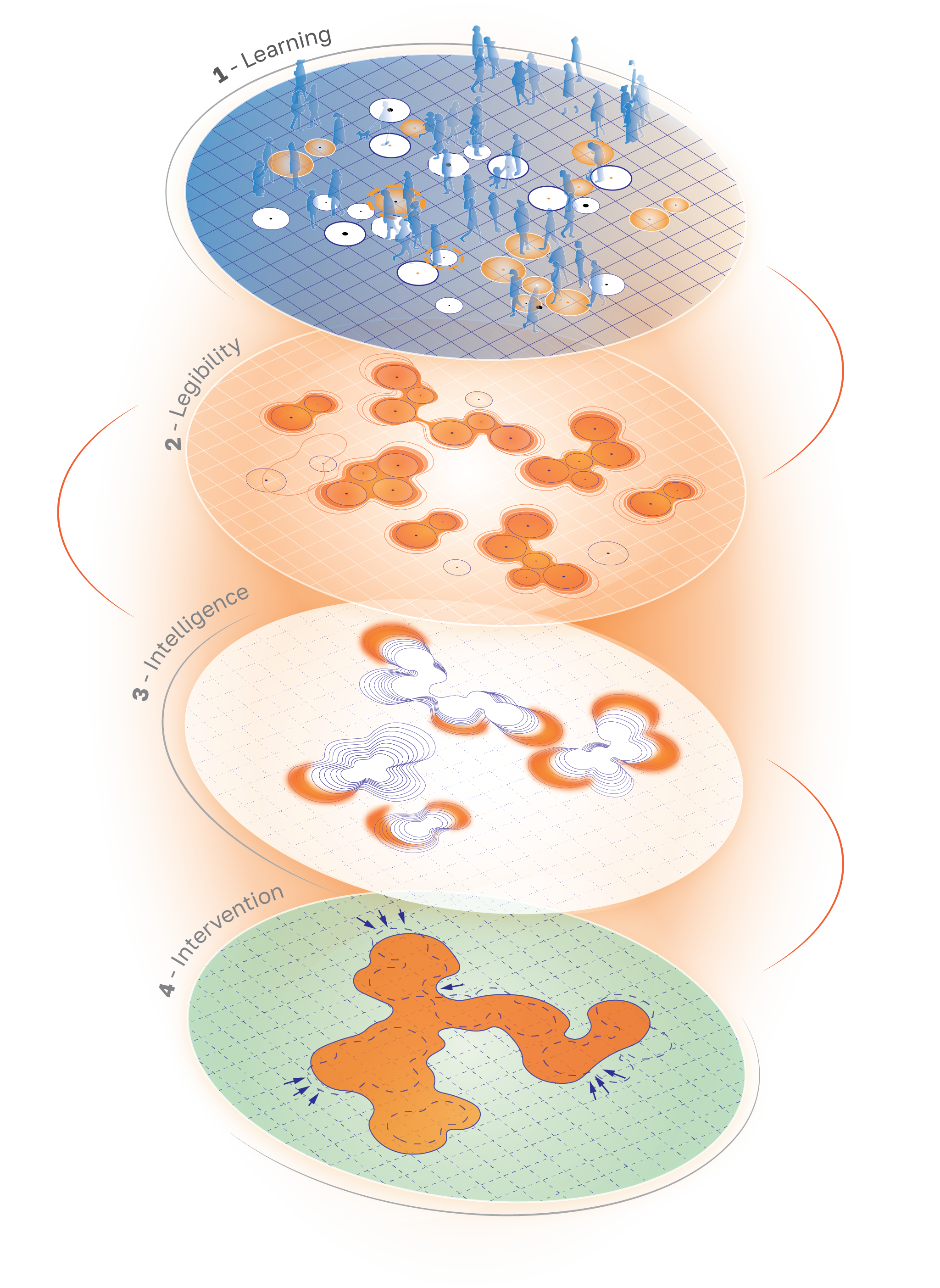
01 LEARNING LAYER

Risk Clinics: Citizen Sensing

Citizen-led civic deliberation spaces for sensing, planning, acting on, and being accountable to .

02 LEGIBILITY LAYER

Visualisation & Mapping

Visualisation tools to make , and legible to diverse stakeholders.

03 INTELLIGENCE LAYER

Assessment & Decision-Making

Foresight capabilities, simulations, and decision-making infrastructure for systemic .

04 INTERVENTION LAYER

Action & Implementation

Implementation infrastructure to translate risk intelligence into concrete interventions and strategies.

The RiskSense Portfolio

Four modular layers designed to work together: risk clinics surface civic-level needs, visualisation tools make systemic risks legible, assessment capabilities provide evidence, and implementation infrastructure translates insights into action. Learning is iterative and adaptive, with insights from each layer feed back in a continuous loop.

Portfolio layers· Select a layer to explore
Currently viewing layer 01 of 04

Risk Clinics

Unlike traditional workshops, Risk Clinics create shared understanding, rehearse responses, surface actionable insights, build relationships, and generate evidentiary pathways that legitimise community knowledge. We offer five distinct clinic types that work as a natural progression:

Clinic Typologies

TypePurposeWhen to use
SensingSurface emerging risks, build collective awareness, identify blind spotsBeginning of adaptation planning, post-crisis sense-making, community-led vulnerability assessments
ActionMove from risk awareness to concrete intervention designTranslating plans into projects, community-led solution development, cross-sector coordination
PlanningIntegrate risk intelligence into formal planning processes and decision-makingDeveloping local adaptation plans, budget structuring and investment prioritisation, masterplan development
AccountabilityTrack progress, evaluate effectiveness, maintain commitmentAnnual review, monitoring, learning & impact evaluation, political accountability
CoordinationEnable cross-boundary collaboration on shared risksCross-departmental coordination, public-private partnerships

Flexible Deployment – The five clinic typologies form a natural progression that enable communities to build institutional memory about what works in their context, and refine approaches over time. Clinics may be deployed as standalone interventions, as an integrated sequence, or as iterative learning cycles.

01

Context: A Crisis of Anticipatory Capacity

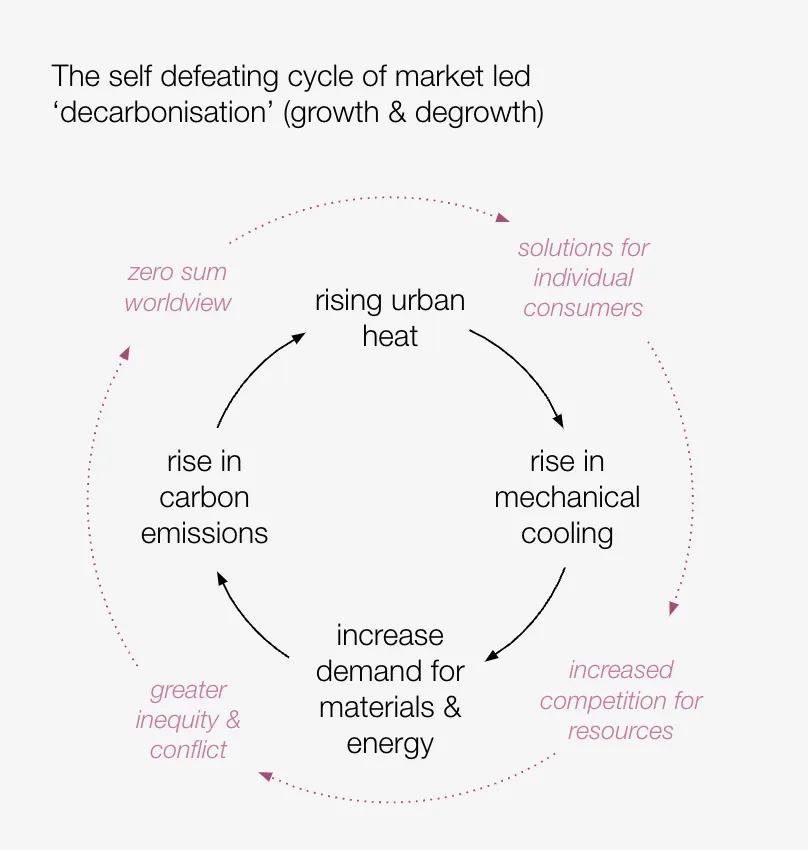
We live in an era of : overlapping, interacting crises that exceed the capacity of traditional risk management systems. Climate breakdown, infrastructure vulnerability, economic precarity, and social polarisation compound in ways that don't respect jurisdictional boundaries, departmental silos, or planning horizons. These risks are systemic in nature and operate through interconnected cascades. For example, escalating temperatures during an urban heatwave compound into power outages, water scarcity, transport failure, and care gaps.

But these cascades remain largely invisible: absorbed as personal misfortune or social apathy, normalised as background noise or distrust in government, or deferred as someone else's problem. The anticipatory capacity to identify, deliberate on, and respond to before they become crises is precisely what is missing. Dominant approaches to risk management, however, operate primarily at two scales:

Institutional or Corporate scale

Sophisticated risk modelling exists for companies, insurance firms, financial institutions, and government agencies. These systems are expensive, proprietary, and focused on protecting institutional interests.

Risk is externalised downward: onto municipalities without resources, onto communities without leverage, onto individuals without choice.

Individual or Consumer scale

Apps and tools provide atomised, reactive information (e.g. flood zone maps, air quality alerts, emergency notifications). These are useful but fragmentary, offering adaptation strategies for those with resources to adapt but little capacity for collective action or systemic response.

Risk remains individualised, absorbed as personal responsibility rather than recognised as governance failure.

Civic scaleStructurally underserved

This is the scale where citizens, communities, municipalities, and local institutions actually live with risk.

At this scale, there is remarkably little infrastructure for:

  • Sensing emerging risks before they become crises
  • Making legible to non-experts
  • Community-led innovation from responses to preparedness
  • Rehearsing responses through structured deliberation
  • Coordinating action across fragmented actors
  • Holding systems accountable to risk reduction commitments
02

The Missing Middle: Citizen Risk Intelligence

The RiskSense change pathway operates through three reinforcing mechanisms.

01

Civic-scale sensing and deliberation infrastructure makes patterns, , and existing resilience capacities legible to communities.

02

Legibility enables across disparate demographics, creating a novel basis for recognition of shared vulnerability, and collective action.

03

Civic stewardship becomes constitutive i.e. municipalities, insurers, financiers, and policymakers become responsive to civic intelligence.

Each mechanism reinforces the same shift: communities who have lived with, adapted to, and built knowledge and resilience to systemic risks across generations become the intelligence infrastructure that institutions are held accountable to.

This is how becomes systemic rather than reactive, and how governance failure becomes legible and addressable rather than normalised and externalised.

RiskSense addresses five critical gaps:

Gap 1: Civic Intelligence Infrastructure

Risk intelligence is abundant at institutional and individual scales but absent at the civic scale where collective action happens.

Opportunity: Build infrastructure for distributed risk sensing that creates actionable civic intelligence and capacity to recognise, interpret, and respond to systemic risk cascades, identifying where coupling constrains agency and where communities have already built resilience capabilities.

Applications: Public health infrastructure, civic tech, democratic innovation, community resilience programs

Gap 2: From Rehearsal to Reality

Many tools help visualise or model risks, but few help communities move from risk awareness to coordinated response. The action gap is massive.

Opportunity: Create spaces where people don't just learn about risks but rehearse responses, identify coordination needs, surface resource gaps, and commit to actions. This is the bridge between scenario planning and actual implementation.

Applications: Disaster preparedness, public health emergency response, climate adaptation implementation grants

Gap 3: Compound Risk Legibility

Most risk assessment tools are single-issue. Systemic risks, however, are nested and entangled. There's little tooling for making compound risks legible at civic scale.

Opportunity: Not just mapping individual risks, but showing how they interact, amplify each other, and create vulnerability cascades. Identify zones of low optionality where interdependencies have removed individual agency and only system-level change can restore choices.

Applications: Climate adaptation, urban resilience, critical infrastructure protection, health equity

Gap 4: Anticipatory Governance at Civic Scale

Growing academic and policy interest in anticipatory governance and futures literacy, but most work remains abstract or high-level. Few practical civic tools exist.

Opportunity: Build infrastructure for civic foresight—helping communities develop the muscle to sense emerging risks, deliberate on futures, and take anticipatory action before crises hit. Support risk stewards with tools, legitimacy, and coordination mechanisms.

Applications: Democratic innovation, civic participation, futures/foresight research, urban governance innovation

Gap 5: From Paralysis to Agency

Systemic risks can be overwhelming, leading to paralysis rather than action. Tools often increase awareness without building agency.

Opportunity: Design processes explicitly for agency-building—not just information sharing but helping people identify leverage points, find collaborators who share material vulnerability, and take meaningful action within their sphere of influence.

Applications: Community organising, civic engagement, climate anxiety/action programs, mental health and resilience initiatives

03

Work with Us

Community organisations

Neighbourhood associations, mutual aid networks, environmental justice organisations, disaster response networks, tenant unions, faith-based groups with community organizing capacity, etc.

Pain point – You see risks emerging every day but lack tools to make these patterns visible, gain legitimacy with decision-makers, or coordinate effective responses across households / neighbourhoods / communities.

What we offer – Methods to document community-observed risks and informal adaptation capacities; platforms to make grassroots intelligence visible to power; coordination infrastructure across groups; evidence to advocate for resources and policy changes.

Municipal networks

Inter-city networks, national municipal associations, regional development agencies, metropolitan planning organizations, emergency management networks, etc.

Pain point – Your member cities have climate plans and risk assessments but struggle to move from analysis to coordinated action. Departments work in silos, you lack community buy-in, and can't track whether interventions are working.

What we offer – Structured frameworks to translate assessments into actionable strategies, participatory processes to build community ownership and political support, coordination mechanisms, accountability tools, evidence base for securing adaptation funding.

Governance & policy bodies

National climate agencies, regional planning authorities, parliamentary committees, intergovernmental organisations, and civic innovation units within government.

Pain point – You have the mandate to act on systemic risk but lack the ground-level intelligence to make policy that communities trust and respond to. Top-down risk assessments don't capture what's actually happening at the civic scale.

What we offer – Civic intelligence pipelines that connect community-level risk sensing to policy processes; evidence frameworks that legitimise community knowledge; participatory mechanisms that build public trust in governance responses.

Research institutions

Universities with urban planning/resilience programs, think tanks focused on governance innovation, policy labs, urban observatories, climate research centers, etc.

Pain point – You produce valuable research on systemic risks, but it rarely translates into practical action. You lack real-world testing grounds and struggle to bridge the theory-practice gap.

What we offer – Living labs for testing anticipatory governance methods, rich qualitative and quantitative data on community risk perceptions, partnerships for co-research and validation, case studies demonstrating real-world impact, platform for knowledge exchange between academic and practitioner communities.

Institutional & financial innovators

Climate funds, foundations & philanthropies, government innovation funds, bioregional financing mechanisms, green banks, insurance providers, blended finance structures, etc.

Pain point – You want to fund climate resilience and community preparedness but struggle to identify high-leverage interventions, assess whether investments are effective, and ensure funding reaches communities most at risk.

What we offer – Transparent frameworks showing how investments translate to risk reduction; evidence of community-driven demand and readiness; mechanisms to track outcomes and hold grantees accountable; models for public-private-community co-investment; portfolio approach that diversifies risk while maximising impact.

Technology partners

GIS platforms (ESRI, MapBox), civic tech organisations, data analytics and visualization firms, sensor/IoT companies, social impact-oriented tech companies, etc.

Pain point – You have technical capacity but need domain expertise in risk governance, participatory methods, and municipal workflows to build tools that communities and governments actually use.

What we offer – Methodology development, user research and co-design processes, integration pathways into municipal and community workflows, validation through real-world deployment.

People

Siddhi Ashar

Siddhi AsharProgram Development & Participatory Foresight Lead Mumbai

Shapes strategic direction, designs participatory research and foresight methodologies, leads the design and delivery of Risk Clinics, and manages key relationships across India, UK, and USA.

Gurden Batra

Gurden BatraCivic Tech Lead Berlin

Designs, builds, and holds digital infrastructure that make civic risk intelligence accessible, actionable, and accountable to the communities it serves. He also holds key relationships in the UK and Europe.

Prateek Shankar

Prateek ShankarProgram Steward & Implementation Lead Berlin

Leads strategic direction and portfolio structuring, drives funder and partner relationships, and sequences the initiative's growth across cities and geographies, spanning Europe, South Asia, North Africa, and North America.

Arianna Smaron

Arianna SmaronInterdisciplinary Designer Basel

Designs the visual identity, design system, and public communications strategy. Translating complex, multi-scalar risk intelligence into a coherent public language that works across cities, institutions, and diverse audiences.

Sofia Valentini

Sofia ValentiniStrategic Designer & GIS Specialist Sao Paolo

Co-shapes strategic direction, maps how risk moves through urban and ecological systems, builds spatial and qualitative data inference tools and portfolio frameworks, and manages partner relationships in Latin America.

Advisors

Indy Johar

Indy Johar London

Advises on civic innovation, institutional design, governance strategy, and positioning.

Eunsoo Lee

Eunsoo Lee Seoul

Advises on product development, civic tech infrastructure, and portfolio design.

06

Resources

Selected writings, case studies, and talks.

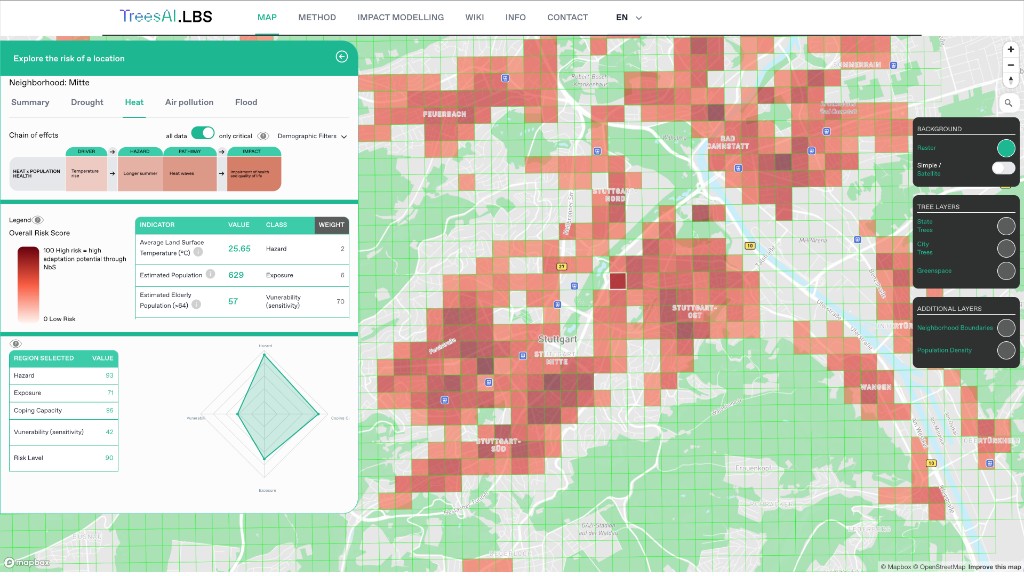
TreesAI is implementing location-based scoring in StuttgartBlog

2024

TreesAI is implementing location-based scoring in Stuttgart

How Stuttgart is piloting TreesAI’s location-based scoring to target tree planting where heat, flood, and social vulnerability intersect.

The Risks We Share: Climate, Conflict, and Continuity in the Hindu Kush HimalayasBlog

2024

The Risks We Share: Climate, Conflict, and Continuity in the Hindu Kush Himalayas

Explores how climate, conflict, and cultural continuity entangle in the Hindu Kush Himalayas, and what this means for shared risk governance.

Melting Borders: Glacier Governance in the Hindu Kush HimalayasCase study

2025

Melting Borders: Glacier Governance in the Hindu Kush Himalayas

Case study on cross-border glacier governance and the institutional arrangements needed to steward shared cryosphere risks.

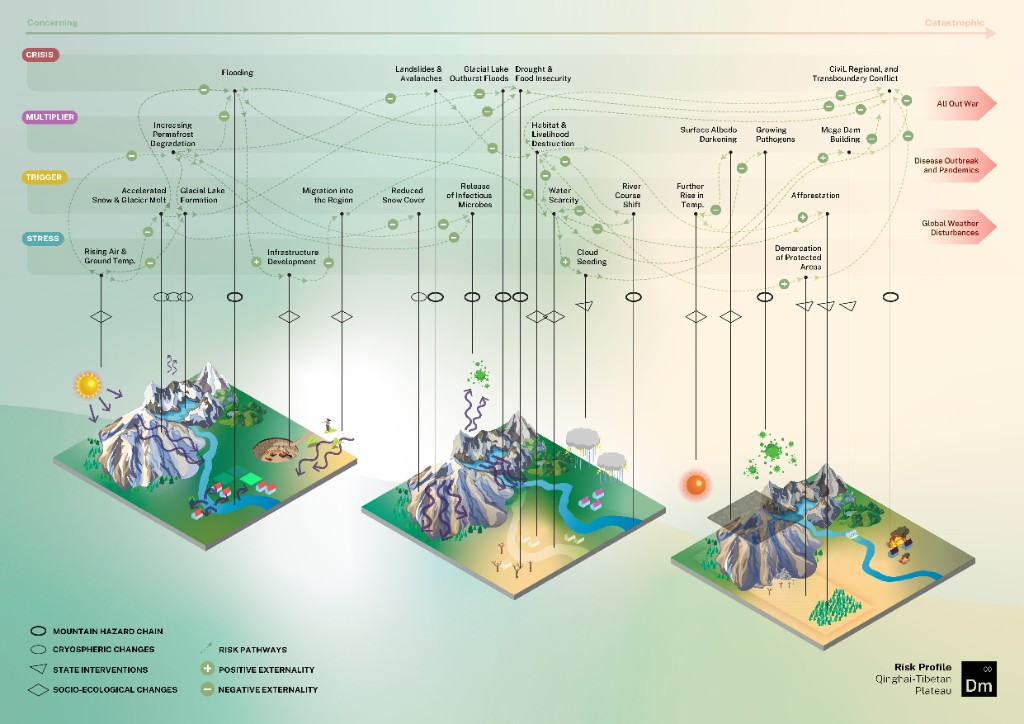
Crisis Landscapes at the Third Pole: Situational Risk Assessment of the Hindu Kush HimalayasReport

2024

Crisis Landscapes at the Third Pole: Situational Risk Assessment of the Hindu Kush Himalayas

75 year risk profile, assessing the compound risk landscape in the Hindu Kush Himalayas, mapping systemic vulnerabilities and opportunities for anticipatory action.

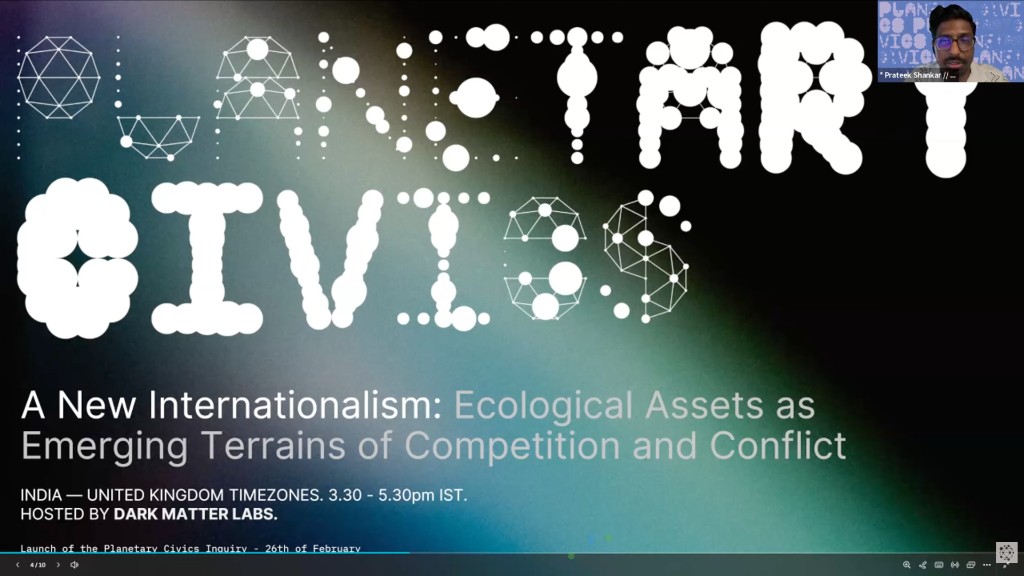
A New Internationalism: Ecological Assets as Emerging Terrains of Competition and ConflictTalk

2025

A New Internationalism: Ecological Assets as Emerging Terrains of Competition and Conflict

Talk on how ecological assets are reshaping geopolitics and what a new, regenerative internationalism might demand of our institutions.

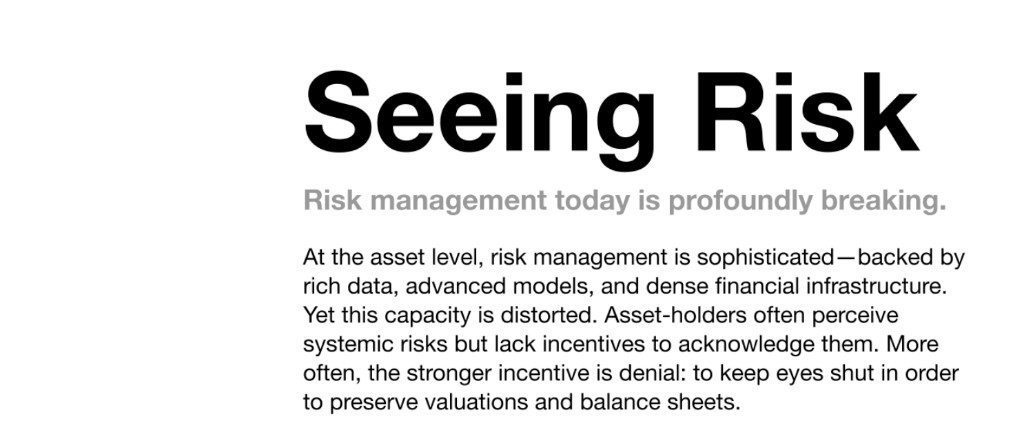
How we see risk shapes our resilience: A discussion on risk managementConversation

2025

How we see risk shapes our resilience: A discussion on risk management

A conversation on why dominant framings of risk produce paralysis, and how reframing risk can unlock collective resilience.

Indy Johar: Civilizational Optioneering — Long Now TalkTalk

2026

Indy Johar: Civilizational Optioneering — Long Now Talk

Long Now talk on building civilizational options for the long term, and the infrastructures required to steward them.

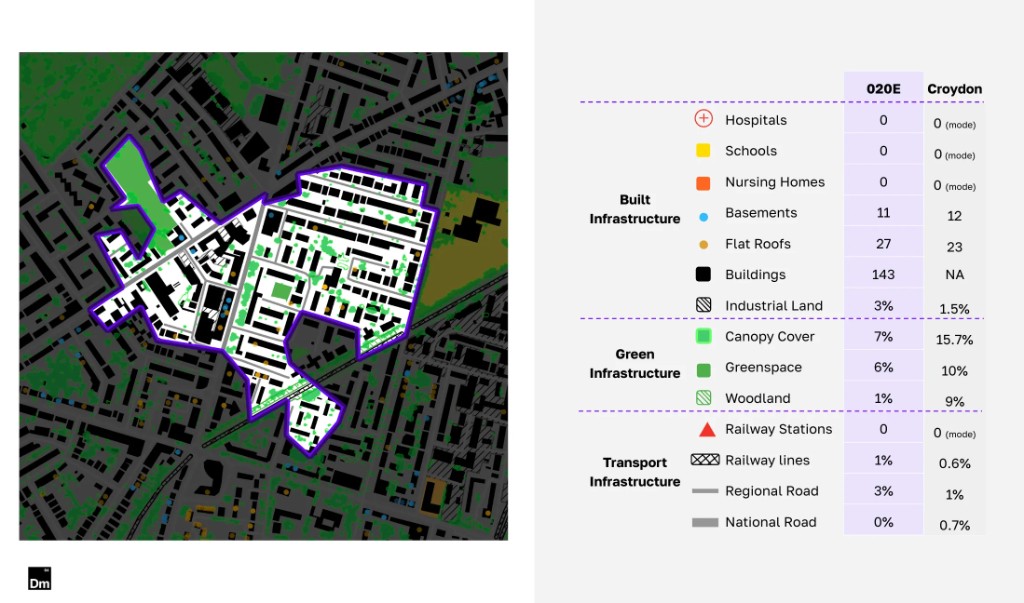
Building Climate Resilience in Croydon: A Data-Driven Approach to AdaptationBlog

Jan 2026

Building Climate Resilience in Croydon: A Data-Driven Approach to Adaptation

Describes how Croydon is using data and civic collaboration to target adaptation investments and build local climate resilience.

TreesAI’s Heat-sensing collaborationBlog

2024

TreesAI’s Heat-sensing collaboration

Highlights TreesAI’s collaboration on urban heat sensing, combining sensor data and civic insight to guide cooling interventions.

Building resilient futures, together.

Get in touch

For more information or to explore partnership opportunities:

risk@darkmatterlabs.org

RiskSense is stewarded by Dark Matter Labs. With thanks to the many thought partners and contributors to this work: Alexandra Bekker, Arianna Smaron, Indy Johar, Zehra Zaidi, Jon Soske, Jorn Verbeeck, Chloe Treger, Leon Seefeld, Rajesh Kasturirangan, among others.